Notting Hill Carnival 2026
Notting Hill Carnival 2026: Europe's largest street festival travel guide
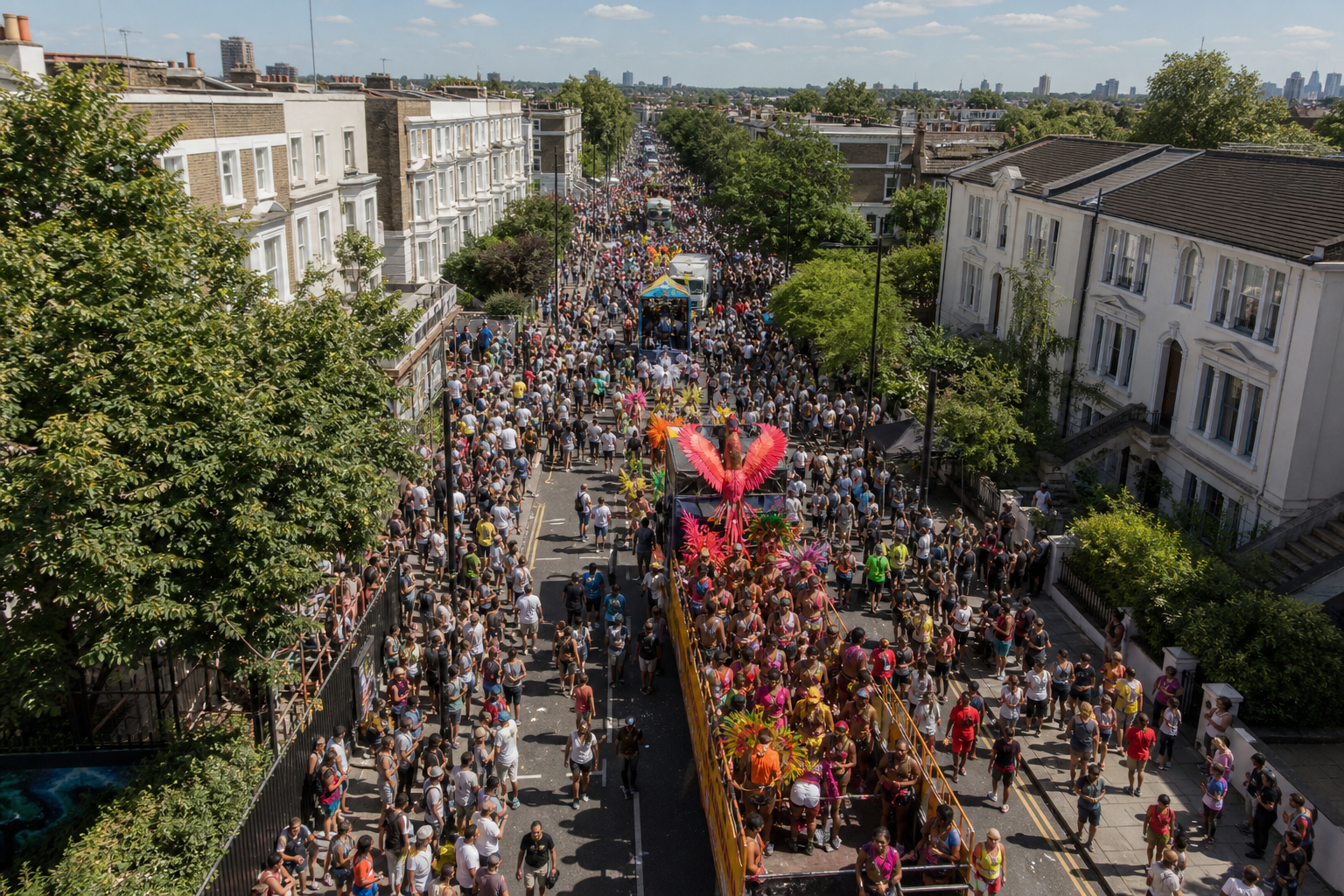
Europe's largest street festival celebrates Caribbean culture in London, routinely bringing together upwards of 1 to 2 million attendees, heavily driven by both domestic and international visitors. This guide covers history, parade routes, sound systems, safety, accommodation, and staying connected with a UK travel eSIM.
2M+
People on the streets over the bank holiday weekend
1966
Year the modern carnival tradition took root
40+
Static sound systems across West London
50+
Mas bands and processions in the main parade
Quick answer
Notting Hill Carnival 2026 takes place on Sunday 30 and Monday 31 August over the bank holiday weekend. Europe's largest street festival is free to attend, draws 1–2 million people, and closes many West London roads — use the Tube, agree meeting points, and install a UK travel eSIM for TfL updates and maps.
History: from Caribbean community gathering to Europe's biggest street party
Notting Hill Carnival's roots stretch to the 1950s, when London's Caribbean community — particularly migrants from Trinidad and Tobago, Jamaica, and Barbados — held indoor ' Caribbean carnival' events to celebrate culture and raise funds after the Notting Hill race riots of 1958. Claudia Jones, a Trinidad-born activist and journalist, organised an indoor carnival at St Pancras Town Hall in 1959, planting a seed that would move outdoors.
The outdoor street carnival as London knows it today crystallised in 1966 when community leader Rhaune Laslett invited Trinidadian-born activist Russell Henderson's steel band to perform a neighbourhood walkabout. That spontaneous procession through Notting Hill streets became the template for future parades. Through the 1970s and 1980s, carnival grew despite political hostility and heavy policing; organisers fought for recognition of Caribbean culture as a public good rather than a nuisance.
By the 1990s and 2000s, Notting Hill Carnival had become a fixture of the British summer calendar, drawing more than a million people annually and generating significant economic impact for West London hospitality. UNESCO recognition of carnival traditions globally helped reinforce its cultural weight. Today it remains free to attend, funded through sponsorship, council support, and volunteer labour — though debates about safety, gentrification, and licensing continue.
Understanding that history matters when you visit. Carnival is not a ticketed stadium concert — it is a living community festival with deep political and cultural meaning. Respect for residents, performers, and traditions is as important as knowing the parade route.
What to expect: parades, sound systems, and Caribbean culture
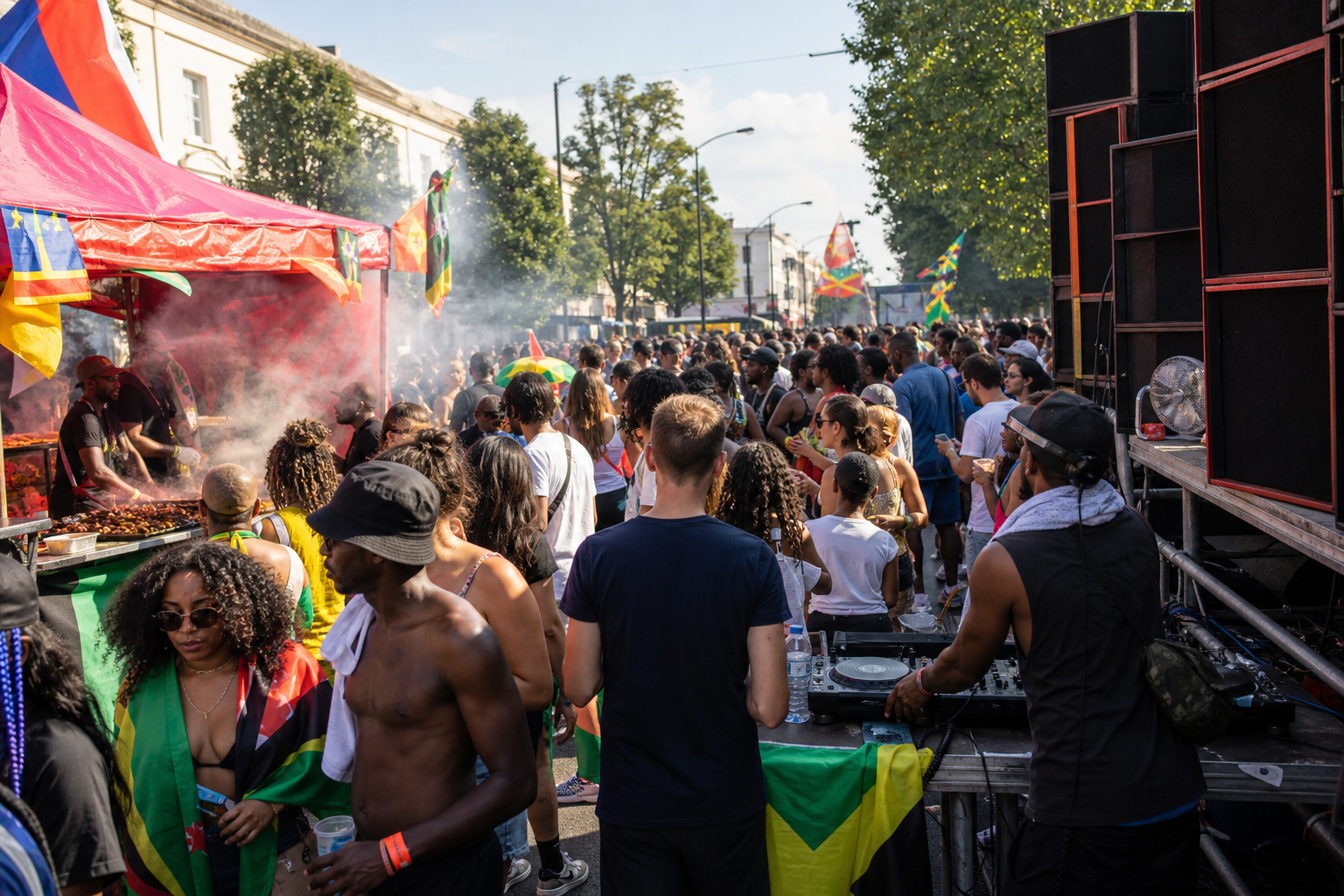
Expect sensory overload in the best sense: steel pan, soca, calypso, reggae, and bashment pouring from static sound systems; mas bands in feathered costumes dancing through West London streets; jerk smoke rising from food stalls; and dense, joyful crowds stretching for miles. Sunday is traditionally 'Family Day' with a slightly calmer tone and earlier finish; Monday is the main parade day with the fullest mas bands and peak attendance.
The parade follows a circular route through W10 and W11, generally moving along Great Western Road, Chepstow Road, Westbourne Grove, and Ladbroke Grove — though exact timings and road closures shift year to year. Static sound systems occupy side streets and parks, each with its own vibe from dub to soca. Famous names like Channel One, Aba Shanti-I, and Saxon Sound draw loyal followings; wandering between systems is part of the ritual.
Food is central: jerk chicken, curry goat, plantain, roti, and rum punch from Caribbean vendors who spend months preparing. Toilets and water points exist but queues are long — plan breaks away from the densest blocks. Weather in late August can be hot; hydration and sun protection matter as much as waterproofs for sudden showers.
Crowds are genuinely massive. If you dislike shoulder-to-shoulder movement, arrive early for a spot near the parade start or retreat to quieter side streets. Children are welcome on Family Day but Monday's crush requires serious planning for families. Accessibility is challenging — the event is largely street-based with limited step-free viewing areas.
Notting Hill Carnival 2026 dates and bank holiday schedule
Carnival takes place over the August bank holiday weekend — the last Monday in August in England and Wales. Plan travel and hotels around road closures and Tube congestion.
Setup & J'ouvert build
- Date 2026
- Sat 29 Aug
- What happens
- Sound checks, early parties, neighbourhood prep.
Family Day (Sunday)
- Date 2026
- Sun 30 Aug
- What happens
- Parade from ~9 a.m.; family-oriented atmosphere.
Main parade (Monday)
- Date 2026
- Mon 31 Aug
- What happens
- Full mas bands, peak crowds, road closures all day.
Bank Holiday Monday
- Date 2026
- Mon 31 Aug
- What happens
- National rail engineering possible — check National Rail.
Post-carnival travel
- Date 2026
- Tue 1 Sep
- What happens
- Heathrow and St Pancras busy with departing visitors.
| Day | Date 2026 | What happens |
|---|---|---|
| Setup & J'ouvert build | Sat 29 Aug | Sound checks, early parties, neighbourhood prep. |
| Family Day (Sunday) | Sun 30 Aug | Parade from ~9 a.m.; family-oriented atmosphere. |
| Main parade (Monday) | Mon 31 Aug | Full mas bands, peak crowds, road closures all day. |
| Bank Holiday Monday | Mon 31 Aug | National rail engineering possible — check National Rail. |
| Post-carnival travel | Tue 1 Sep | Heathrow and St Pancras busy with departing visitors. |
Parade route and sound system map basics
Exact timings shift annually, but these landmarks anchor most visits:
- Ladbroke Grove — heart of the procession and densest crowds.
- Westbourne Park / Great Western Road — strong mas band viewing.
- Powis Square & static systems — dub and reggae corners.
- Portobello Road — market energy meeting carnival routes.
- Paddington & Bayswater — easier hotel access with Tube links.
Getting there: Tube, rail, and navigating road closures
Notting Hill sits in West London between Paddington, Ladbroke Grove, and Westbourne Park. On carnival weekend, many roads close to cars entirely — assume you will arrive on foot or by public transport. London Underground stations near the route include Notting Hill Gate, Ladbroke Grove, Westbourne Park, and Royal Oak; all become extremely congested with exit-only or queuing systems in peak hours.
National Rail serves Paddington (Heathrow Express, Great Western) and nearby stations — often faster than the Tube if you are coming from outside London. Plan extra time for every journey; a 20-minute normal trip can become 60 minutes. Santander Cycles and e-scooters are options for reaching outer perimeter streets, but riding through the parade route itself is impossible and unsafe.
If you are flying into London, Heathrow (LHR), Gatwick (LGW), and City (LCY) all connect via rail or Tube. Install a UK travel eSIM before landing so live TfL status, Google Maps reroutes, and meet-up messages work underground-adjacent and in crowded signal zones.
- Use TfL Go or Citymapper for live station closures — Notting Hill Gate often restricts entry.
- Agree a meeting point away from the parade core if your group splits up.
- Arrive before 11 a.m. Sunday or Monday for calmer entry to the route.
- Avoid driving — residential permit zones and tow-away enforcement are strict.
- Late evening: plan your route home before sound systems wind down.
Where to stay: West London, Zone 1 alternatives, and booking windows
Hotels and rentals inside W10/W11 book months ahead for carnival weekend — and prices spike sharply. If you want to walk to the route, target Notting Hill, Ladbroke Grove, Bayswater, or Paddington, but expect minimum stays and high rates. Many visitors stay in Kensington, Shepherd's Bush, or central Zone 1 and Tube in for a few hours.
Airbnb in residential streets near the route can be lucrative for hosts but noisy for guests — read reviews about carnival weekend specifically. Hostels in Paddington and Bayswater offer budget beds with reasonable access. Always confirm check-in times; some properties restrict arrivals during parade hours.
Combining carnival with Edinburgh Fringe earlier in August is a popular international itinerary — book a single UK eSIM for both cities rather than paying daily roaming twice. Refundable hotel rates are worth the premium given weather and flight uncertainty.
Mobile data and UK eSIM tips for carnival weekend
Carnival is a phone-heavy event: live maps, TfL alerts, photo uploads, social stories, and coordinating friends in crowds where shouting fails. Cellular networks strain under hundreds of thousands of simultaneous users — data may slow even with full bars. Wi-Fi in nearby cafés clogs quickly. International roaming at $10–$15 per day from US or Canadian carriers adds up across a long weekend; a prepaid UK eSIM with 10–20 GB is usually cheaper and more predictable.
Install your eSIM before travel, disable home-SIM data roaming, and label lines clearly. Download offline Tube maps and screenshot your hotel address. A power bank is essential — you may be outdoors from morning until night. If you use mobile payments for food stalls, keep a backup card and some cash; contactless works widely but stall connectivity varies.
For visitors touring multiple UK events in August — Fringe, carnival, then perhaps Royal Ascot or city breaks — compare Europe-wide eSIM plans versus UK-only packages based on your full route.
- Install UK eSIM on home Wi-Fi before departure.
- Download TfL Go, Citymapper, and offline maps.
- Screenshot hotel details and meeting points.
- Carry power bank and charging cable.
- Disable auto-upload for photos until on hotel Wi-Fi.
Practical tips: safety, etiquette, and what to bring
Safety in crowds
Pickpockets target carnival crowds. Use front-facing bags, avoid back pockets, and do not flash expensive phones at the parade barrier.
Respect residents
Many live on the route year-round. Do not urinate in doorways, block driveways, or climb garden walls — use official facilities.
What to wear
Comfortable shoes, sun hat, light layers, and optional bright colours if you want photos to pop. Avoid stilettos on uneven streets.
Children and accessibility
Family Day Sunday is easier for kids. Wheelchair viewing areas exist but are limited — check official carnival accessibility info early.
Food and hydration
Eat early, carry water, and pace alcohol — heat plus crowds dehydrate quickly. Cash helps at smaller stalls.
After carnival
Restaurants across West London fill Monday evening. Book dinner or plan a quieter neighbourhood if you want to decompress.